
Adderall is one of the most common prescriptions used to treat attention deficit hyperactivity disorder, helping those that struggle to stay focused. However, many people have heard about Adderall’s benefits and decided to try it for themselves, outside a doctor’s direction. If it can help people with ADHD focus and think clearly, it’s assumed, maybe it can help us do the same.
Unfortunately, the effects of medications are rarely that straightforward. For many people, taking Adderall may not be so smart.
Key Takeaways: How Does Adderall Work?
- Adderall is the brand name for mixed amphetamine salts, including amphetamine and dextroamphetamine.
- It is one of the most common prescriptions used to treat attention deficit hyperactivity disorder.
- It stimulates the release of neurotransmitters, leading to an increase in focus.
- It is commonly used by students and professionals as a smart drug, to assist in focus, memory, thinking, and general cognition.
- While Adderall may increase focus in people without ADHD, it can also cause a decrease in effective cognition.
- Adderall is potentially habit-forming and stopping use can cause dangerous withdrawal symptoms.
- Pregnant women and nursing mothers are advised to avoid taking Adderall if possible, as it can pose a danger to their children.
What Is Adderall?
Adderall is the brand name of medication often prescribed for attention deficit hyperactivity disorder (ADHD), or as it was known in the past, attention deficit disorder. While most people are familiar with the name Adderall, they may not realize that it is a form of amphetamine. Technically, it is made up of mixed amphetamine salts, including amphetamine and the somewhat stronger dextroamphetamine [1].
Amphetamines are, of course, well-known stimulant drugs, so it may seem odd to give it to someone who is already hyperactive. However, stimulant medications are successfully used to treat ADHD due to their effect on brain chemistry, increasing focus and attention.
ADHD medications are also frequently used outside the direction of a health care professional, though it’s illegal to do so. Primarily, Adderall is used as a study drug, despite not being very effective for that purpose [2].
How Does Adderall Work Chemically?
Adderall is a central nervous system stimulant drug. That means it revs up both voluntary functions, like movement and motor function, and autonomic functions like heart rate [3]. In the brain, it stimulates the release of the neurotransmitters dopamine, epinephrine, and norepinephrine.
Those compounds are an important part of the reward pathway, which governs motivation and focus, among other things. They also can bind to dopamine nerve terminals, stimulating dopamine receptors in a similar way to dopamine itself. In therapeutic doses, these two functions work together to counteract the effects of ADHD.
Higher doses may overstimulate these functions, leading to some adverse reactions.
What Is Adderall Used For?
As we’ve mentioned, Adderall is one of the most common stimulant drugs used for treating attention deficit hyperactivity disorder. It’s estimated 60% of children with ADHD are prescribed some sort of stimulant treatment, mostly divided between Adderall and Ritalin, or generic versions [4].
Additionally, it is sometimes used to treat narcolepsy. However, it’s likely that, other than ADHD, the most common use is as a study aid. Adderall is one of several illicit drugs that have a reputation for being ‘smart drugs’, improving focus, memory, and reasoning ability [5].
Really, that sort of drug use is prescription drug abuse. It can lead to an Adderall addiction and drug dependence that can be hard to kick, sometimes even requiring a medical detox program.
Adderall and ADHD: How Does Adderall Help?
As we’ve mentioned, Adderall addresses ADHD symptoms by stimulating certain aspects of brain chemistry to improve focus. While we don’t entirely understand the cause, ADHD patients seem to have a deficit of certain neurotransmitters, namely dopamine, epinephrine, and norepinephrine [6].
Prescription stimulants like Adderall address that deficit by activating aspects of brain chemistry to produce more of those compounds.
What is the most common way of treating ADHD?


What Does Adderall Do To the Brain?
Stimulant drugs like Adderall activate the central nervous system, prompting it to make more of a class of compounds called catecholamines, which include dopamine, epinephrine, and norepinephrine. All are important, but dopamine is particularly important for treating ADHD, as it is involved in the reward pathway.
That’s important as, though the connection isn’t obvious, the reward pathway is a large part of what drives focus. In some ways, humans are problem-solving machines, figuring out ways to get food, shelter, companionship, and everything else we need. When we’re able to focus on a problem and solve it, the reward system produces dopamine to give us a boost.
Amphetamines like Adderall also prevent dopamine and other compounds from being absorbed or broken down for other uses. Combined with creating more, dopamine levels end up generally elevated [7]. As a result, staying focused is easier.
Too much amphetamine exposure can occur when using high doses illicitly to help study, or just to chase a high. Among a number of ill effects, this can build tolerance or even make it more difficult to stay focused.
How Does Adderall XR Work?
Adderall XR refers to an extended-release version of the drug. Its effects are similar to taking two smaller doses of immediate-release Adderall about four hours apart.
Stimulant medication like Adderall usually takes effect in short order and lasts for only a short time. The effects of Adderall when taken in immediate release peak after about three hours, when it’s at its maximum plasma concentration, and lasts for about four hours total.
If you were to take it first thing in the morning, the effects would wear off around lunchtime. Oral administration might have a small effect on that timing.
For a longer-lasting effect, an Adderall XR capsule is full of microbeads, each containing a small amount of Adderall [8]. Half is released immediately, while the beads prevent half from being absorbed immediately. As a result, Adderall XR reaches peak effectiveness in about seven hours, with effects lasting for eight to 12 hours [9].
In the past, Adderall XR has been linked to sudden cardiac death in patients with underlying heart conditions. Caution is, therefore, a good idea.
Adderall Side Effects
Adderall is a form of amphetamine, so it is open to all the same dangers and side effects as any form of that drug. Some side effects may appear even when used according to a doctor’s direction. Adverse reactions are more likely to occur and be serious when used illicitly.
Some common side effects are:
- An increase in heart rate or high blood pressure.
- Headaches or trouble sleeping.
- Weight loss.
- Dry mouth.
- Decreases appetite.
- Anxiety and panic attacks.
- Mood swings.
Chronic amphetamine use over time generally produces more extreme forms of those same side effects. Some examples of these effects include:
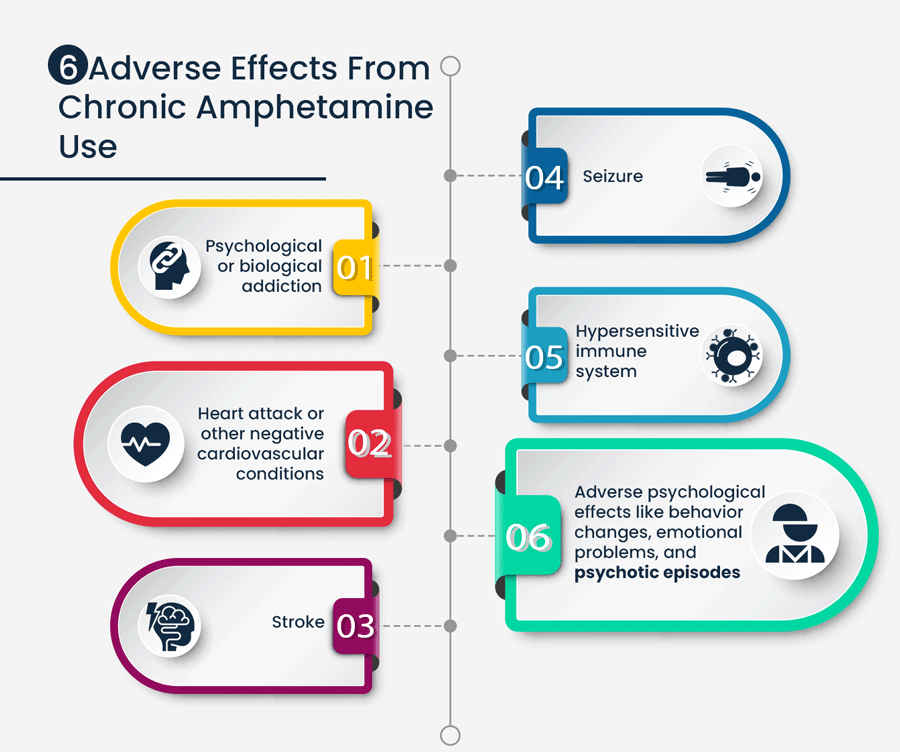
- Psychological or biological addiction.
- Heart attack or other negative cardiovascular conditions.
- Stroke.
- Seizure.
- Hypersensitive immune system.
- Adverse psychological effects like behavior changes, emotional problems, and psychotic episodes.
Some of these are the result of neurotoxic effects, similar in many ways to methamphetamine-induced neurotoxicity [10]. Brain functions are altered, leading to disruption or even death of neurons [11]. Adderall neurotoxicity symptoms include all of the more serious side effects mentioned.
Additionally, there is some evidence Adderall use can lead to the earlier onset of bipolar disorder [12]. When more serious side effects appear, addiction treatment may be necessary.
Adderall Side Effects In Females
Females who use Adderall are at an increased risk of developing an eating disorder. Additionally, Adderall and pregnancy may not mix well.
While most studies have been performed on rats, Adderall use may increase risk factors for low birth weight and birth defects, including spina bifida [13]. Adderall will also show up in breast milk, so nursing mothers may want to avoid it.
Common Risks While Taking Adderall
Beyond side effects, there are many risks with Adderall. Like all drugs, there is the potential for negative interaction with other medications. There is also a risk of addiction, which in turn causes a number of further risks.
One kind of drug that is common, but which can interact negatively with Adderall, is tricyclic antidepressants [7]. Among those are included common treatments for depression, including amitriptyline, amoxapine, and Norpramin. They tend to increase the effects of amphetamines, increasing the risk of adverse effects, up to and including sudden death.
Mixing Adderall with other stimulants is generally a bad idea, as stimulants interact in such a way as to increase the effects in unpredictable ways.
Adderall abuse can lead to addiction, which can include all the risks already mentioned. Additionally, some risks come with an Adderall crash, when you stop taking the drug. Adderall withdrawal symptoms include:
- Fatigue.
- Trouble sleeping or sleeping too much.
- Nerve and movement disorder.
- Increased appetite.
- Nad dreams.
- Drug cravings [14].
How Do You Know Adderall Is Working?
The only way to know if a drug has kicked in is by monitoring your body and judging the effects. Adderall use should improve the symptoms of ADHD, which tend to fall into two categories, inattentiveness, and hyperactivity [5].
Symptoms of inattentiveness include:
- Difficulty focusing.
- Short attention span.
- Difficulty sticking with a task.
- Forgetfulness.
- Difficulty staying organized.
Symptoms of hyperactivity and impulsiveness include:
- Difficulty sitting still.
- Excessive talking and interrupting.
- Unable to wait your turn.
- Little sense of danger.
Adderall is a stimulant drug, so you may also feel effects similar to caffeine, including excess energy and jitteriness. Adderall XR will have similar effects, though they may not be intense and last for longer.
How Long Does It Take for Adderall To Kick In?
Immediate release Adderall reaches its peak effectiveness about three hours after ingestion. Adderall XR will take longer, peaking at an average of about seven hours [9].
It’s difficult to estimate how long you’ll have to wait for the first effects, as it can depend on a wide array of factors including genetics, body weight, tolerance, and a long list of others.
How Does Adderall Work on Someone Without ADHD?
The chemical effects will be largely similar, including an increase of neurotransmitters and activation of dopamine cells. There may be an increase in focus as a result. However, for someone without ADHD, those effects can have additional consequences.
For example, while the focus is improved, complex memory becomes less reliable [4]. Other aspects of cognition are also negatively impacted. The emotional side effects already described, such as mood swings and anxiety, are also likely. Both effects may make studying or test-taking more difficult.
When used by someone who doesn’t have ADHD, taking Adderall is a form of drug abuse. Adderall addiction shares many of the dangers that amphetamine addiction, or addiction generally, can cause.
Substance abuse can lead to physical dependence and increased risk-taking. Additionally, while users may start with low doses, they eventually start taking larger amounts. The chances of adverse events such as we’ve already discussed increase with high doses.
To safely stop taking Adderall at that point, it’s important to seek out the assistance of a medical professional as withdrawal symptoms can be dangerous.
Reasons Why Adderall Is Not Working?
One likely reason any prescription medicine may stop working as effectively is drug tolerance. Essentially, your body becomes accustomed to your regular dose of medication. To continue to experience benefits, you need a larger dose.
Adderall tolerance can occur fairly quickly when taking prescribed doses. The process is likely to be sped up when taking larger, illicit doses.
A drug interaction is also potentially the cause. Some multivitamins can reduce the effectiveness of Adderall, as can some antacids and other compounds.
The Best Adderall Alternatives
As a smart drug, it’s fair to say that Adderall is underwhelming. It may improve one area of cognition but can worsen other aspects. You may also end up suffering withdrawal symptoms or other problems.
Luckily, there are less dangerous and more effective alternatives. Supplements like nootropics contain herbal and natural ingredients that can help focus, calm, memory, and other aspects of cognition. They are less powerful, but therefore also less risky.

Mind Lab Pro
At the top of the list is Mind Lab Pro, containing a compound sometimes known as a natural Adderall, citicoline. While some supplements lack scientific evidence for their claims, citicoline has been associated with improved cognition in a number of ways [15].
Other ingredients include vitamin B and maritime pine extract, both of which can help maintain healthy brain function in the future[16][17]. Learn more in our Mind Lab Pro review.
Performance Lab
While we’ll probably never see OTC Adderall, Performance Lab Mind can help with focus and cognition. It also contains citicoline to help focus, remember, and think clearly. It has some neuroprotective ingredients, as well.
What makes this option stand out is the standardization of ingredients. Every bottle of a supplement may not be the same, as ingredients can have different strengths or concentrations. Performance Lab puts their ingredients through a standardization process, so everything has the same impact.
Check it out in more detail in our Performance Lab nootropics review.
FAQ
If you’re more interested in some simple answers than brain chemistry, we’ve got you covered.
How Long Does It Take For Adderall To Kick In After Taking It?
There’s no simple way to predict when you may start to feel the effects of Adderall as it depends on a number of factors, some of which may change from moment to moment. The effects of a dose of immediate-release Adderall will peak about three hours after taking it. For Adderall XR, the peak is around seven hours after ingestion [9].
How Should Adderall Make You Feel?
Ideally, Adderall will help you focus without having any other effect. In practice, you’re likely to experience several other effects as well. Some of the most noticeable may be similar to a big cup of coffee or dose of caffeine, including jitteriness and excess energy.
In some cases, those effects can include elevated heart rate, increased anxiety, or even panic attacks.
What Does Adderall Do to a Normal Person?
It may improve focus. It is also likely to make it harder to remember things or make reasoning more difficult. There will also be a range of physical effects, including elevated heart rate, increased blood pressure, increased body temperature, and more.
Why Does Adderall Calm Me Down?
Adderall stimulates the release of dopamine, among other neurotransmitters. You may have heard of dopamine in some places referred to as the ‘feel-good drug.’ It’s partly responsible for feelings of well-being and satisfaction, which are actually linked in some subtle ways to improved focus.
How Long Does 20mg of Adderall Last?
The duration of effect depends on a range of factors, including genetics, body weight, and more. However, for immediate-release Adderall, the effects are estimated to last between four and six hours. Effects of extended-release Adderall XR may last for eight to 12 hours [9].
Conclusion
People with ADHD take Adderall because it can help supplement a lack of focus and attention. When someone who doesn’t suffer the effects of ADHD takes it, the mechanism may be the same, but the effects can be wildly different. A doctor’s prescription is required for a good reason, to avoid substance abuse.
Luckily, there are a bunch of less dangerous, more effective options out there. Natural, traditional remedies such as nootropics may offer more effective alternatives for smart drugs.
References:
- Martin, Dustin. “Amphetamine.” StatPearls [Internet]., U.S. National Library of Medicine, 3 Aug. 2021, www.ncbi.nlm.nih.gov/books/NBK556103/.
- Kerna, Nicholas A, et al. “Adderall: On the Razor’s Edge of ADHD Treatment, Enhanced Academic and Physical Performance, Addiction, Psychosis, and Death.” Research Gate, 30 Nov. 2020, www.researchgate.net/publication/346784016_Adderall_On_the_Razor’s_Edge_of_ADHD_Treatment_Enhanced_Academic_and_Physical_Performance_Addiction_Psychosis_and_Death.
- “NCI Dictionary of Cancer TERMS.” National Cancer Institute, www.cancer.gov/publications/dictionaries/cancer-terms/def/cns-stimulant.
- Lakhan, Shaheen E, and Annette Kirchgessner. “Prescription Stimulants in Individuals with and without Attention Deficit Hyperactivity Disorder: Misuse, Cognitive Impact, and Adverse Effects.” Brain and Behavior, Blackwell Publishing Inc, Sept. 2012, www.ncbi.nlm.nih.gov/pmc/articles/PMC3489818/.
- Weyandt, Lisa L., et al. “Neurocognitive, Autonomic, and Mood Effects OF Adderall: A Pilot Study of Healthy College Students.” MDPI, Multidisciplinary Digital Publishing Institute, 27 June 2018, www.mdpi.com/2226-4787/6/3/58/htm.
- Bélanger, Stacey A, et al. “Adhd in Children and Youth: Part 1-Etiology, Diagnosis, and Comorbidity.” OUP Academic, Oxford University Press, 24 Oct. 2018, academic.oup.com/pch/article/23/7/447/5142942?login=true.
- “Adderall (CII).” Accessdata.fda.gov, Federal Drug Administration, Mar. 2007, www.accessdata.fda.gov/drugsatfda_docs/label/2007/011522s040lbl.pdf.
- McKeage, Kate, and Lesley J. Scott. “SLI-381 (Adderall XR®).” CNS Drugs, Springer International Publishing, 29 Aug. 2012, link.springer.com/article/10.2165/00023210-200317090-00006.
- Shoar, Nazila Sharbaf. “Dextroamphetamine-Amphetamine.” StatPearls [Internet]., U.S. National Library of Medicine, 5 June 2021, www.ncbi.nlm.nih.gov/books/NBK507808/.
- Fitzgerald, Kevin T., and Alvin C. Bronstein. “Adderall® (Amphetamine-Dextroamphetamine) Toxicity.” Topics in Companion Animal Medicine, W.B. Saunders, 21 June 2013, www.sciencedirect.com/science/article/abs/pii/S193897361300024X.
- “Neurotoxicity Information Page.” National Institute of Neurological Disorders and Stroke, U.S. Department of Health and Human Services, www.ninds.nih.gov/Disorders/All-Disorders/Neurotoxicity-Information-Page.
- DelBello, Melissa P, et al. “Prior Stimulant Treatment in Adolescents with Bipolar Disorder: Association with Age at Onset.” Wiley Online Library, John Wiley & Sons, Ltd, 24 Jan. 2002, onlinelibrary.wiley.com/doi/abs/10.1034/j.1399-5618.2001.030201.x.
- Louik, Carol, et al. “Increasing Use of Adhd Medications in Pregnancy.” Pharmacoepidemiology and Drug Safety, U.S. National Library of Medicine, Feb. 2015, www.ncbi.nlm.nih.gov/pmc/articles/PMC4313616/.
- “The Amphetamine Withdrawal Syndrome.” Department of Health | The Amphetamine Withdrawal Syndrome, www1.health.gov.au/internet/publications/publishing.nsf/Content/drugtreat-pubs-modpsy-toc~drugtreat-pubs-modpsy-3~drugtreat-pubs-modpsy-3-7~drugtreat-pubs-modpsy-3-7-aws.
- Fioravanti, M., & Buckley, A. E. (2006). Citicoline (Cognizin) in the treatment of cognitive impairment. Clinical interventions in aging, 1(3), 247–251. https://doi.org/10.2147/ciia.2006.1.3.247
- Kennedy D. O. (2016). B Vitamins and the Brain: Mechanisms, Dose and Efficacy–A Review. Nutrients, 8(2), 68. https://doi.org/10.3390/nu8020068
- Rohdewald P. A review of the French maritime pine bark extract (Pycnogenol), a herbal medication with a diverse clinical pharmacology. Int J Clin Pharmacol Ther. 2002 Apr;40(4):158-68. doi: 10.5414/cpp40158. PMID: 11996210.
Leave a Reply