
Adderall has brought relief to many people with attention deficit hyperactivity disorder (ADHD). However, in the process, Adderall abuse has also become common. With a reputation for making you smarter, it’s no wonder overworked students are willing to give it a try. Unfortunately, they are probably trading very minor benefits for a slew of serious risks.
Key Takeaways: Adderall Abuse
- Adderall is a drug used to treat ADHD.
- Adderall is unlikely to improve mental performance if you don’t have ADHD.
- Adderall is an amphetamine and considered a controlled substance.
- It is possible to develop an addiction to Adderall.
- It is possible to overdose on Adderall.
- Adderall abuse can have life-threatening impacts on your health.
What Is Adderall?
Adderall is the brand name of popular prescription drugs used to treat attention deficit hyperactivity disorder (ADHD) [1]. It is also approved to treat narcolepsy. The generic name is mixed amphetamine salts, consisting of both amphetamine and dextroamphetamine.
Adderall is a central nervous system stimulant, with effects on both voluntary and involuntary functions [2]. It is one of the more common treatment options for ADHD. A range of other drugs are also used to treat the disorder, including Ritalin and Focalin.
As we’ll examine more closely, there is a great deal of illicit Adderall use, usually as a study drug.
How Does Adderall Work?
Someone with ADHD is likely to have lower than average levels of the neurotransmitter dopamine. Like many prescription drugs used for treating ADHD, Adderall increases the production of dopamine.
Dopamine is part of the brain’s reward center and is used to encourage us to do things that help us survive, like find food or build shelter. With healthy levels of dopamine, we’re better motivated to solve problems and therefore find it easier to focus.
What Does Adderall Do to a Normal Person?
It’s important to get the dosage correct when you treat ADHD, as more Adderall isn’t always better. It therefore follows, a neurotypical person taking Adderall may increase dopamine levels to an unhealthy degree. It can have effects on both physical and mental health, including:
- High blood pressure.
- Seizures.
- Trouble sleeping.
- Mood swings.
- Psychotic episodes [2].
Taking Adderall outside a doctor’s direction is a form of prescription drug abuse, with a risk of addiction. Additionally, while Adderall abuse may cause a minor increase in focus, it doesn’t seem to significantly improve memory or cognition.
What Is Adderall Abuse?
Drug abuse is defined as compulsive use of a substance despite negative consequences. Practically speaking, if you’re not treating attention deficit hyperactivity disorder or narcolepsy under a doctor’s care, you’re abusing Adderall.
Students are most likely to abuse Adderall, particularly college students. It’s seen as a study drug, as the increased focus is equated to greater intelligence. However, whatever benefits it has seem to be limited, likely outweighed by the adverse effects experienced when someone abuses Adderall.
Adderall abuse usually leads to tolerance, high doses, and addiction. Some users report snorting Adderall for a quick high. Mixing Adderall with alcohol use is also common.
Statistics of Adderall Abuse in the United States
Methylphenidate, otherwise known as Ritalin, may actually be more commonly abused than Adderall. However, some colleges have reported that more than 25% of their students used prescription stimulants without a prescription [3]. In 2009, it was estimated one in five high school students had used a prescription drug illicitly [4].
Most of the Adderall is supplied through diversion, in which students with legitimate prescriptions give or sell pills to others [5]. As nearly 10% of children have been diagnosed with ADHD, there is a large supply [6].
Most people cite cognitive enhancement as the reason for abuse, using Adderall as a smart drug [7]. Substance abuse is often associated with other mental illness, as well.
Which gender was found to be more likely to misuse Adderall in college?


Common Signs of Adderall Abuse
Adderall and caffeine are both central nervous system stimulants. Their effects may seem somewhat similar, with both causing things like:
- Restlessness.
- Headache.
- Dizziness.
- Trouble sleeping.
Adderall abuse usually means higher doses than would be taken with a prescription, so signs could include those symptoms and more serious versions.
Among these other Adderall abuse signs, it’s common for those abusing Adderall to also use a variety of other drugs, including alcohol [8].
Side Effects of Adderall Abuse
The side effects of Adderall are generally manageable when taken in prescribed doses. When used at the level of substance abuse, there is a higher risk of adverse effects. Since Adderall is an amphetamine, too much Adderall is similar in effect to that type of drug use.
Short-Term Effects
Even in the short term, the side effects of Adderall abuse can be quite serious. As we’ve mentioned, therapeutic doses can raise a person’s blood pressure. Higher doses put a greater strain on the system so that high blood pressure becomes a heart attack. Effects also include impacts on mental health or even sudden death.
Other short-term side effects of higher doses include:
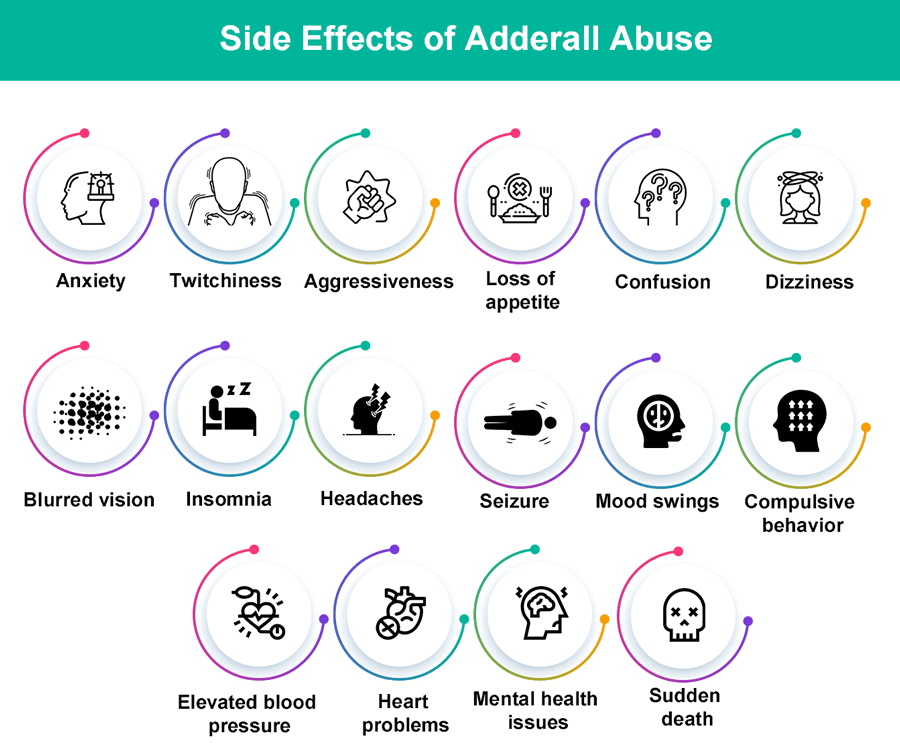
- Anxiety.
- Twitchiness.
- Aggressiveness.
- Loss of appetite.
- Confusion.
- Dizziness.
- Blurred vision.
- Insomnia.
- Headaches.
- Seizure.
- Mood swings.
- Compulsive behavior.
Long-Term Effects
There have been no long-term studies of Adderall use, either in therapeutic doses or used illicitly. However, prolonged Adderall abuse will be broadly similar to any sort of amphetamine abuse.
One of the chief effects is most likely a build-up of tolerance, in which larger doses are required over time to achieve the desired effects. That leads rapidly to physical dependence and addiction. At that point, ceasing use can lead to dangerous Adderall withdrawal symptoms.
Abusing amphetamines has also been known to cause mental disorders. Psychotic episodes are most often cited, though amphetamines have also been known to cause schizophrenia-like symptoms [9]. It’s possible that using amphetamines at a younger age also makes you vulnerable to bipolar disorder [10].
The damage to the cardiovascular system also increases over time. Increased blood pressure over prolonged periods makes cardiovascular disease more likely. Irregular heartbeats and a weakened heart are also possible.
How Does Adderall Affect the Brain?
In addition to producing dopamine, Adderall also prompts the brain to make several other neurotransmitters, including adrenaline, norepinephrine, and serotonin [11].
Dopamine gets the spotlight because it’s useful in treating a variety of illnesses, producing a feeling of wellness. It’s also the driving factor in most substance addiction, as users chase that pleasurable sensation. When dopamine levels drop, as the drug wears off or the user quits using, Adderall withdrawal symptoms occur.
Adderall and Depression
While Adderall is not approved for use in treating depression or anxiety, many people with ADHD also suffer from those conditions [12]. Stimulant drugs that produce dopamine are sometimes used to treat depression, so Adderall may have some benefits there.
However, that is also likely to be a reason Adderall is abused to a dangerous degree. Addicts often suffer from depression and use drugs to self-medicate. Unfortunately, amphetamines have also been known to cause depressive symptoms, leading to a dangerous downward spiral [13].
Personality Changes While Taking Adderall
Adderall can cause changes in mood and behavior, or worsen already existing issues. Amphetamines generally can cause extreme mood swings. Increases in anxiety can also lead to panic attacks and paranoia. Adderall may also cause aggressiveness.
More serious mental health problems may also be caused. Psychosis and mania are the most commonly cited dangers. Using Adderall may also cause serotonin syndrome, causing hallucinations, agitation, and delusions.
Physical Effects of Adderall Addiction
At this point, it should be obvious that Adderall abuse and addiction result in some serious health risks. We’ve looked at some of the immediate physical and mental side effects of using Adderall. Some physical effects already discussed include:
- Weight loss.
- Increase blood pressure.
- Higher risk of cardiovascular disease.
- Increased risk of heart attack.
- Twitchiness or tremors.
- Seizures.
In younger people, there is a possibility Adderall’s properties can suppress growth. Additionally, it may cause damage to blood vessels or lead to a rare condition called Raynaud’s phenomenon [1]. Other serious physical effects could include:
- Serious skin rash.
- Necrosis of the skin.
- Alopecia.
- Dissolution of muscle tissue [14].
- Increased body temperature.
Recognizing the Signs of Adderall Addiction
The range of potential adverse effects may make prescription stimulant use seem terrifying. However, most of them only appear in rare or particularly severe cases. It’s much more difficult to spot Adderall drug addiction in earlier stages. Despite that, there are several signs you can look for.

Physical signs include things like:
- Sudden weight loss.
- Tiredness and lethargy.
- Sleep problems.
- Twitchiness.
Behavioral signs include things like:
- Dramatic mood swings.
- Manic episodes.
- Aggressiveness.
- Repetitive behaviors.
In extreme cases, users may experience formication hallucinations, characterized by itchiness without apparent cause. Paranoia and bizarre delusions are also possible. Additionally, stimulant drug use masks the effects of alcohol, making alcohol poisoning more likely [15].
Drug addiction can also make itself known in other aspects of life, such as poor personal hygiene or losing contact with friends.
Intervention and Next Step Options
It is certainly possible to overcome addiction to Adderall. However, it may require professional addiction treatment or a stay at a treatment center. Withdrawal from amphetamines can cause some serious health issues. Additionally, if you attempt to take a higher dose after going through withdrawal, your odds of overdosing are much higher.
Unfortunately, there are no drugs that would make Adderall addiction treatment easier [16]. There are a number of behavioral options that might help, however. More information can be found on the Substance Abuse and Mental Health Services Administration website.
Adderall Alternatives: Nootropics
The most commonly given reason for Adderall abuse is cognitive enhancement. In simple terms, it has a reputation for making you smarter. Adderall probably doesn’t live up to that reputation.
Drugs meant to make you smarter are called nootropics. While many are so potent as to be dangerous, there are some supplements that are safer and cheaper. They may not rev your mental motor as much as stimulant medication, but they also are less likely to grind your gears.
Benefits of Nootropics
Most nootropics work along broadly similar lines as Adderall. Dopamine production is encouraged, which activates the reward centers of the brain. That provides some mental motivation, providing neurochemical resources for solving problems. As a result, nootropics for motivation are often the most effective option.
Nootropic supplements will also often include ingredients that have neuroprotective properties. Rather than providing a mental boost at the cost of brain health, nootropic supplements may actually leave your brain healthier.
Types of Nootropics
Legal, safe nootropic options are usually supplements that you take on a regular basis. They provide a general, consistent boost in focus, concentration, and memory, as well as supporting good brain health.
These are a couple of our favorite options, containing safe and useful ingredients.
Mind Lab Pro
Mind Lab Pro uses an array of ingredients to help you focus, as well as providing a range of other benefits. In particular, Mind Lab Pro relies on citicoline to serve as an Adderall alternative, mildly upping dopamine production [17].
Additionally, all their products contain sustainable ingredients and are shipped in environmentally responsible packaging. Find out more in our detailed Mind Lab Pro review.
Performance Lab Nootropic
Similar in many ways to Mind Lab Pro’s offering, Performance Lab Mind also contains citicoline as a way of increasing dopamine, and therefore motivation. Other ingredients prevent oxidative damage or provide raw materials for making more dopamine [18][19].
If that sounds interesting, take a closer look at our Performance Lab Pro review.
FAQ
If you’re less interested in brain chemistry and more interested in simple answers, this is the section for you.
What Are Adderall Addiction Symptoms?
Addiction to Adderall will have many of the same symptoms as any sort of addiction, including behavior changes and a narrowing of interest. Symptoms specific to Adderall can include:
- Dropping weight suddenly.
- Sleep problems.
- Twitchiness.
- Mood swings.
- Repetitive behaviors.
- Aggressiveness.
What Happens If You Take Adderall Without ADHD?
You may find that your ability to focus improves slightly. However, you’re also likely to:

- Become more anxious.
- Have difficulty sitting still.
- Become dizzy or confused.
- Have an increased heart rate.
- Become nauseous.
- Develop headaches.
Can I Get Better Grades on Adderall?
If you do, you might want to consider being tested for ADHD. Otherwise, Adderall is as likely to be a hindrance as a help in school work. In people without ADHD, Adderall causes a range of negative effects that are likely to interfere with doing well at school.
Is It Possible to Overdose on Adderall?
It is absolutely possible to have a life-threatening overdose on Adderall. As an amphetamine, Adderall is a potent drug that can strongly affect your system in many ways. Additionally, one of the potential side effects is sudden death.
Conclusion
Under the direction of a doctor, Adderall can be of benefit to some people. However, abusing Adderall is gambling with your health with no real chance of winning. After all, if the pill really made you smarter, you’d probably be wise enough to stop taking it.
References:
- “Adderall CII.” Access Data, Federal Drug Administration, www.accessdata.fda.gov/drugsatfda_docs/label/2017/011522s043lbl.pdf.
- Shoar, Nazila Sharbaf. “Dextroamphetamine-Amphetamine.” StatPearls [Internet]., U.S. National Library of Medicine, 5 June 2021, https://www.ncbi.nlm.nih.gov/books/NBK507808/.
- Weyandt, Lisa L., et al. “Neurocognitive, Autonomic, and Mood Effects of Adderall: A Pilot Study of Healthy College Students.” MDPI, Multidisciplinary Digital Publishing Institute, 27 June 2018, https://www.mdpi.com/2226-4787/6/3/58/htm.
- “Media Statement.” Centers for Disease Control and Prevention, Centers for Disease Control and Prevention, 3 Jan. 2010, https://www.cdc.gov/media/pressrel/2010/s100603.htm.
- Darredeau, Christine, et al. “Patterns and Predictors of Medication Compliance, Diversion, and Misuse in Adult Prescribed Methylphenidate Users.” Human Psychopharmacology, U.S. National Library of Medicine, 22 Dec. 2007, https://pubmed.ncbi.nlm.nih.gov/17910020/.
- “Data and Statistics about ADHD.” Centers for Disease Control and Prevention, Centers for Disease Control and Prevention, 23 Sept. 2021, https://www.cdc.gov/ncbddd/adhd/data.html.
- Sussman, Steve, et al. “Misuse of ‘Study Drugs:” Prevalence, Consequences, and Implications for Policy.” Substance Abuse Treatment, Prevention, and Policy, BioMed Central, 9 June 2006, https://www.ncbi.nlm.nih.gov/pmc/articles/PMC1524735/.
- Meisner, Jessica R, et al. “Extended Release Stimulant Medication Misuse with Alcohol Co-Administration.” Journal of the Canadian Academy of Child and Adolescent Psychiatry = Journal De L’Academie Canadienne De Psychiatrie De L’enfant Et De L’adolescent, Canadian Academy of Child and Adolescent Psychiatry, Nov. 2008, https://www.ncbi.nlm.nih.gov/pmc/articles/PMC2583913/.
- Lakhan, Shaheen E, and Annette Kirchgessner. “Prescription Stimulants in Individuals with and without Attention Deficit Hyperactivity Disorder: Misuse, Cognitive Impact, and Adverse Effects.” Brain and Behavior, Blackwell Publishing Inc, Sept. 2012, https://www.ncbi.nlm.nih.gov/pmc/articles/PMC3489818/#b37.
- DelBello, Melissa P, et al. “Prior Stimulant Treatment in Adolescents with Bipolar Disorder: Association with Age at Onset.” Wiley Online Library, John Wiley & Sons, Ltd, 24 Jan. 2002, https://onlinelibrary.wiley.com/doi/abs/10.1034/j.1399-5618.2001.030201.x.
- Vasan, Sarayu, and Garth J Olango. “Amphetamine Toxicity.” Europe PMC, 10 July 2021, https://europepmc.org/article/NBK/nbk470276.
- Coughlin, Catherine G, et al. “Meta-Analysis: Reduced Risk of Anxiety with Psychostimulant Treatment in Children with Attention-Deficit/Hyperactivity Disorder.” Journal of Child and Adolescent Psychopharmacology, Mary Ann Liebert, Inc., Oct. 2015, https://www.ncbi.nlm.nih.gov/pmc/articles/PMC4617411/.
- Leventhal, Adam M, et al. “Anhedonia Associated with Stimulant Use and Dependence in a Population of American Adults.” American Psychological Association, American Psychological Association, 2010, https://psycnet.apa.org/record/2010-26426-012.
- Torres, Patrick A, et al. “Rhabdomyolysis: Pathogenesis, Diagnosis, and Treatment.” The Ochsner Journal, The Academic Division of Ochsner Clinic Foundation, 2015, https://www.ncbi.nlm.nih.gov/pmc/articles/PMC4365849/.
- “Commonly Used Drugs Charts.” National Institute on Drug Abuse, 20 Aug. 2021, https://www.drugabuse.gov/drug-topics/commonly-used-drugs-charts#prescription-stimulants.
- Shoptaw, Steven J, et al. “Treatment for Amphetamine Withdrawal.” The Cochrane Database of Systematic Reviews, John Wiley & Sons, Ltd, 15 Apr. 2009, https://www.ncbi.nlm.nih.gov/pmc/articles/PMC7138250/.
- Jasielski, Patryk, et al. “Application of Citicoline in Neurological Disorders: A Systematic Review.” MDPI, Multidisciplinary Digital Publishing Institute, 12 Oct. 2020, https://www.mdpi.com/2072-6643/12/10/3113/htm.
- Rafnsson, Snorri Bjorn, et al. “Antioxidant Nutrients and Age-Related Cognitive Decline: A Systematic Review of Population-Based Cohort Studies.” European Journal of Nutrition, U.S. National Library of Medicine, 7 June 2013, https://pubmed.ncbi.nlm.nih.gov/23744025/.
- “Tyrosine.” Tyrosine – Health Encyclopedia – University of Rochester Medical Center, https://www.urmc.rochester.edu/encyclopedia/content.aspx?contenttypeid=19&contentid=Tyrosine.
Leave a Reply